nsaitinfra Passive Network
nsaitinfra provides a comprehensive solution for passive networking thanks to our team of skilled technicians and our project management expertise. This enables us to efficiently manage even the most extensive and intricate UTP/Fiber Optic Cabling requirements.
Some of the Passive Network Components & Solutions are:
Structured cabling has become increasingly common for connecting the numerous active devices in an IP network. To support structured cabling, various passive components are employed, including:
components are frequently used in IP networks:
- Cat 6 UTP (Unshielded Twisted Pair) Copper Cables: These cables connect PCs/endpoints to network switches. They can also link switches if the distance doesn't exceed 90 meters, as they support data transmission without the need for a repeater (switches serve this purpose).
- Cat 6 UTP Patch Cords: These are factory-crimped cables, typically one or two meters long, with RJ-45 connectors at both ends. They shouldn't be directly connected to network switches or PCs/endpoints. Instead, patch cords link both devices through an I/O Box and UTP patch panel.
- I/O Box and Face Plate: Placed near computers, the I/O Box and Face Plate connect to the network port on the PC using a UTP patch cord. The Cat 6 UTP cable from the switch terminates behind the I/O Box.
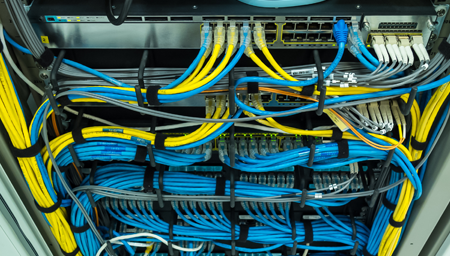
- UTP Patch Panel: This panel terminates all Cat 6 Cables from various PCs/endpoints in the network (essentially the I/O Boxes) to the rack. These cables are permanently connected behind the panel, and UTP Patch Cords connect from the front ports to network switches. This setup allows for flexible changes without affecting the switch ports. Each port on the patch panel is labeled for easy identification of the connected node.
- Optical Fiber Cables: These cables are used when data needs to be transmitted over distances exceeding 90 meters. Optical Fiber Cables use light, rather than electrical signals like UTP cables, and can carry data over longer distances, sometimes even several kilometers without requiring signal repeaters. There are two types: Single Mode (for high-bandwidth requirements over longer distances) and Multi-Mode (for shorter distances). These cables connect directly to the Fiber Patch Panel at both ends and are often available in multiples of 6 cores (e.g., 6 Core, 12 Core, 24 Core). Each connection uses two cores, one for transmitting and the other for receiving data.